Saturday, 7 February 2015

Meet Ulysses

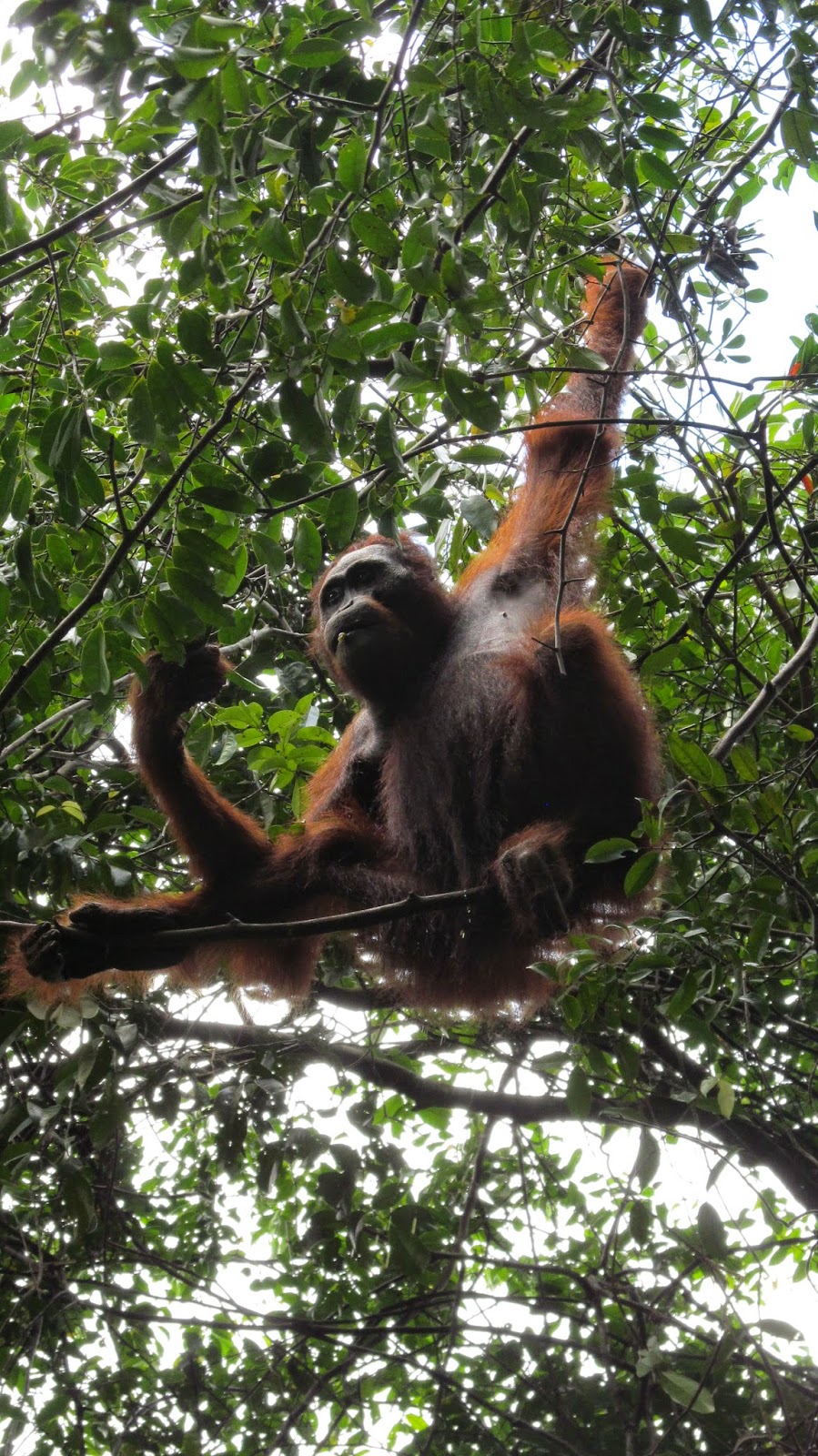
Ulysses, an unflanged male.
This past week I had the chance to go with two of the primate staff members, Uji & Unyil, on an orangutan follow, although it wasn’t the first time I’d seen them & in fact not the first time I met Ulysses. He’s been hanging around in the trees around camp for several days, making it pretty easy to find him in the morning.
Uji collecting urine samples.
Forest lunch

The pattern of primate research, after groups of apes have been habituated to human presence, is to first search for your subject. That involves teams of 2 or 3 people walking transects in the forest, stopping at frequent intervals and looking and listening for your target. There are three primate species studied here; orangs, gibbons and red langurs, the last being the most challenging to find in the forest. Orangutans tend not to move as far (except for young males), gibbons sing in the morning, so are a bit easier to locate, and red langurs - well, I’m not sure how people find them yet. They’re smaller and more secretive. Anyways, after you’ve found your apes, you follow them, which means that gibbon and langur staff may have to travel longer distances and move more often, while Ulysses lounged around within 50 meters of camp for over 5 hours, munching on leaves and occasionally moving over to a different tree. (Male orangutans will spend most of their time alone; another pair of staff members were following a mother and baby farther away from camp.)

Unyil watching Ulysses up in the trees.

On the previous day, staff could watch
Ulysses from a chair in camp, with a
hot coffee from the kitchen.
The routine is consistent; every 5 minutes record what your subject is doing and how far he’s moved, with his current GPS location. Collect urine and faeces samples (at this point I’d like to reiterate why I’m a forester - trees don’t poop).

So while it was a pretty easy day, I had an excuse to leave the follow at 11:00 am (office work in town). My co-workers had to stay and record everything Ulysses did until he made a nest for the night and settled down, which is typically close to dusk (5 or 5:30). Considering that the day started at 5 am to be in place under the sleeping tree Ulysses chose last night, it turns out to be a long haul. Staff members usually follow apes for 3 days in a row, after which they are assigned work in the nursery or on butterfly surveys, which is a more reasonable 7 hour day.


The best part of the day for me was getting to know Uji and Unyil better. Between the 5-minute data collection points there’s a lot of time to chat & joke. And that’s one of the critical parts of my job; to build strong relationships with the staff. So I’ll be going out on more follows and searches, collecting fruiting and flowering data for tree species, identifying butterflies, picking up litter fall from leaf traps and helping with the reforestation project. Which will all be very welcome breaks from the office work and administrative details that fill a lot of my typical day!


Saturday, 3 January 2015

A different forest entirely

Hang around here long enough & you just might be tracked, measured or observed - it’s going around. Scientific studies are thick on the ground along with the more recent addition of active conservation programs like reforestation and peatland restoration. In short, an incredibly productive place with reams of data collected on a daily basis. 

The Indonesian umbrella organization here (acronym: CIMTROP) is centred at Palangka Raya university - they own the camp & land around it which includes the large study area. OuTrop operates the field camp under a collaborative agreement & brings in mostly international researchers, assistants, interns and volunteers. The project was established originally to track and observe orang-utans in the wild - behavioural, nutritional, social studies, etc. etc. It expanded to include gibbons and red langurs as more people pursued new research. To properly observe these wildlife groups they must first be habituated to human presence over several years so that they won’t react and behave atypically when a couple of people are crouching in the bush watching their every move. 

Numbers of researchers and assistants on site per year vary according to which study projects are accepted, but have been rising over the last several years due to the addition of tree phenology and biodiversity studies (butterfly and fish surveys are two of these currently in progress). 
Southern Bornean gibbon


In the last month I was able to get out in the forest three times, once with a couple of visitors and the Field Director, Berni, to see if we could find some orangs - we didn’t, but met the gibbon trackers who were observing a mom & baby pair. I imagine after a long day you might need a neck massage - look up, way up, to check the animals’ activities at regular intervals (I think about every 5 minutes). The work day for primatologists stretches from when their subjects leave their sleeping places early in the morning until they bed down at night - anywhere from 6 to 10 or even 12 hours later. 


Berni checking out the gibbons,
Twenti & Helene collecting data. 


All sorts of interesting plants & insects can be seen on a short walk, and many of the mobile variety just visit you in camp. A pit viper (left) was hanging out in a small tree by one of the cabins & the wild pig diner is just outside our dining room.

Other forms of life can be seen relaxing after days in the field collecting data or in the office collating it.


CIMTROP patrol team building
a dam using stems cut from the
surrounding woods.
Meter-high seedlings from the
 forest are planted on top of the dam
 to stabilize it further.
The third day in the woods I went along with the CIMTROP patrol team to take pictures while they built two dams in one of the old logging canals. They may look narrow with slow-moving water, but these waterways lace through extensive areas of the peat forest. Intentionally dug several decades previously in order to make access via small boats & wood extraction easier. As a consequence, the canals drain water from the peat soil making the forest highly susceptible to wildfires in an area which is not at all adapted to fire. The Sabangau forest is now a conservation area, and one of the most important preservation steps is to build and maintain dams on the canals, to keep water pooling in the lowland forest.

A second smaller dam is built
upstream to slow water flow
as much as possible.

Scene from camp 3 weeks ago
Camp last week, water is rising.


I’ll have the chance to tag along with each of the projects, but since the rainy season has now started it’ll be a bit damp - sloshing on forest paths that can be hip deep in water. Ah well, that’s one sign of a healthy peatland tropical forest.


Thursday, 4 December 2014

Second First Impressions

It’s always tricky starting a new job - always stressful, at least I’ve found it so. In situations where I haven’t felt completely inadequate for at least the first couple of days, the work didn’t challenge me and had no potential for growth. Trust me, right now I’m stressed. I can only offset the feeling by telling myself that this just might turn out to be the best job I’ve ever had. I have no doubt it will be (another) steep learning curve.

So here I am in Palangka Raya, provincial capital of Central Kalimantan in Indonesian Borneo. Fast & dirty geography lesson (or recap for those of you who stuck with my blog - by the way, I love you). Indonesia sprawls out between the Indian Ocean and Pacific Ocean, almost 2 million square kilometers of land area nestled in over 5 million square kilometers of territorial area. While many foreigners have heard of Borneo and Bali you’d be surprised at how many don’t realize that these are just two of the country’s 17,000 islands (give or take a few hundred). Checking population on some websites, estimates vary from 240 to 270 million people - imagine a margin of error equivalent to Canada’s entire population.

Borneo itself is shared by Indonesia (the bulk of southern land area), Malaysia in the north, with the small country of Brunei located in the northwestern corner. There are 5 provinces in the Indonesian part of the island: North, West, East, South and Central Kalimantan provinces & if you live or visit here you would usually say you’re going to Kalimantan, not Borneo.

First impressions when comparing to South Sulawesi - it’s a little closer to the equator, but seems hotter not because of that. The area is flat, flat, flat. Apparently more mountainous in the interior but from the little bit I’ve seen so far the area around Palangka Raya has very little elevation. So it’s a change for me from the cool hills in Bengo-Bengo. Different vegetation - but I’ll leave the intensely interesting botanical discourse for (much) later after I’m more familiar with the local ecology, tropical peat forests. The city is quite small compared to Makassar, quiet, much less traffic, but my new office mates tell me that it’s had a sudden spurt of development just in the last few years. A new Hypermart (one of my favourite places for cheap household goods), a Mata Hari clothing department store, cinema, new hotels and apparently yogurt & cheese can now be found locally, so I’m all set.

So getting back to the stress - my new job is Operations Manager for the Orangutan Tropical Peatland Project (OuTrop), a research and conservation organization that partners with the local university, Universitas Palangka Raya and their conservation group CIMTROP. OuTrop itself was originally established by several researchers from the UK working on (surprise) orangutans, and has branched out over the last 15 years or so to include other wildlife studies, forestry and ecological projects, etc. etc. But why reiterate (and massacre) a good description of the organization when you can find it at outrop.com.

I have a long job description which may be summarized by the phrase “run things smoothly” - primarily the logistics of the station. Again, first impressions - there are several staff members responsible for research, communications, finances, camp management etc. There’s an office in town and a field station in Sabangau forest, about an hour away by road, boat & small rail. I’ll visit that tomorrow to see the set up and meet the staff there. Anyways, the staff all seemed happy to meet me, maybe because they’ve been filling in the gaps for several months of what will be my job. 

Other news: language skills are coming back, I’m meeting tons of new people involved in the projects here, still not crazy about Indonesian food, but I brought my favourite coffee mug from home & am freely indulging in good coffee again. Pictures to follow.

Monday, 1 December 2014

Don't Ask Why

Friends & family in Canada were curious about why I wanted to go back to Indonesia & as soon as possible. Beyond the usual ‘skipping the cold winter’ I didn’t, & still don’t, have an answer. But there’s a feeling here that I don’t get at home, that is maybe explained through an anecdote.

Before leaving again I had to get a passport-sized photo of myself with a red background for the visa application. Sounds easy, right? Conceding that Fredericton is a small town with a limited demand for portrait studios, one of which had just closed its doors, there remained about half a dozen larger and smaller businesses. I called all of them & none of them could meet the requirement of a red background, except Walmart as long as I could ignore the Christmas tree blocking out a lot of the solid red. The answers were ‘No, sorry, can’t do that’. End of discussion.

Now, if I had asked on any commercial street in a similar-sized town in Indonesia for a blue background (they all have red for the official photos) the answer would rarely have been ‘no’. It would have been ‘well, no I don’t have that, but my brother knows a guy who works two streets over who may be able to do that’ or ‘no, but if you want to pay this guy to go and buy a blue sheet of paper, he will bring it back and then I can take your picture’, or ‘no, but why do you need that?’ which would devolve into a long discussion of the funny things different governments require for official purposes.

(Sidenote: The above example also illustrates why I find Canadians teaching entrepreneurship to Indonesians laughable.)

Maybe that’s why I like it - there just seem to be so many rich possibilities in every small daily transaction & nothing seems impossible. When I started learning the language I gathered a lot of my Indonesian vocabulary from books & flipping through the dictionary, so the foundation was proper language, not everyday use in conversation. So when I used one of the words I’d learned - “mustahil” - one of my friends didn’t understand what I was trying to explain. Mustahil - dictionary definition - means ‘impossible’. My friend laughed. “We never use that word - we just say ‘tidak mungkin’”. Which means ‘not possible’, or conveys the meaning ‘improbable’. It may sound subtle but ‘not possible’ leaves that gap for chance to slip through. In Canada, many things are mustahil, in Indonesia, nothing seems to be.

Taking off the rosy specs, often you can’t get what you want or need here. The answer may be ‘next week’ or ‘next month’ and you may be continually put off until it becomes evident that you’re just not going to get what you want. Part of this is due to the cultural tendency to politely answer any demand, even obviously unreasonable ones. But part of it really is optimism in what the future may bring. So, maybe what really explains my feelings about the country is ‘lie to me, I still love you’.

But - maybe - life is pretty much the same here as in Canada, without polar vortices. Just in a different language so everything seems new & more exciting. That’s entirely possible & how would I ever know if that’s not the case? I’ll write more about how returning is going in the next post. No doubt it will be a new experience (again) - new job, different island - I can’t wait to start. Right after all the bureaucratic hoops in Jakarta have been negotiated.

In the end, I got my red background in Fredericton - went to Fabricville, bought a meter of red cotton, went back to the Walmart studio where I received the most positive negative & helped the friendly portrait artist hang the cloth from her curtain rod. Voila - an official passport photo against red rather than white background. Tidak mustahil after all.

Thursday, 20 March 2014

These are the people in my neighborhood...

I'm occasionally (or actually, all the time) accused of not having any people in my pictures. Can I help it if my camera keeps shifting to the landscape & trees? So, in my last week here, I made a special effort & here are some of the people I've worked & played with in Sulawesi. Enjoy!

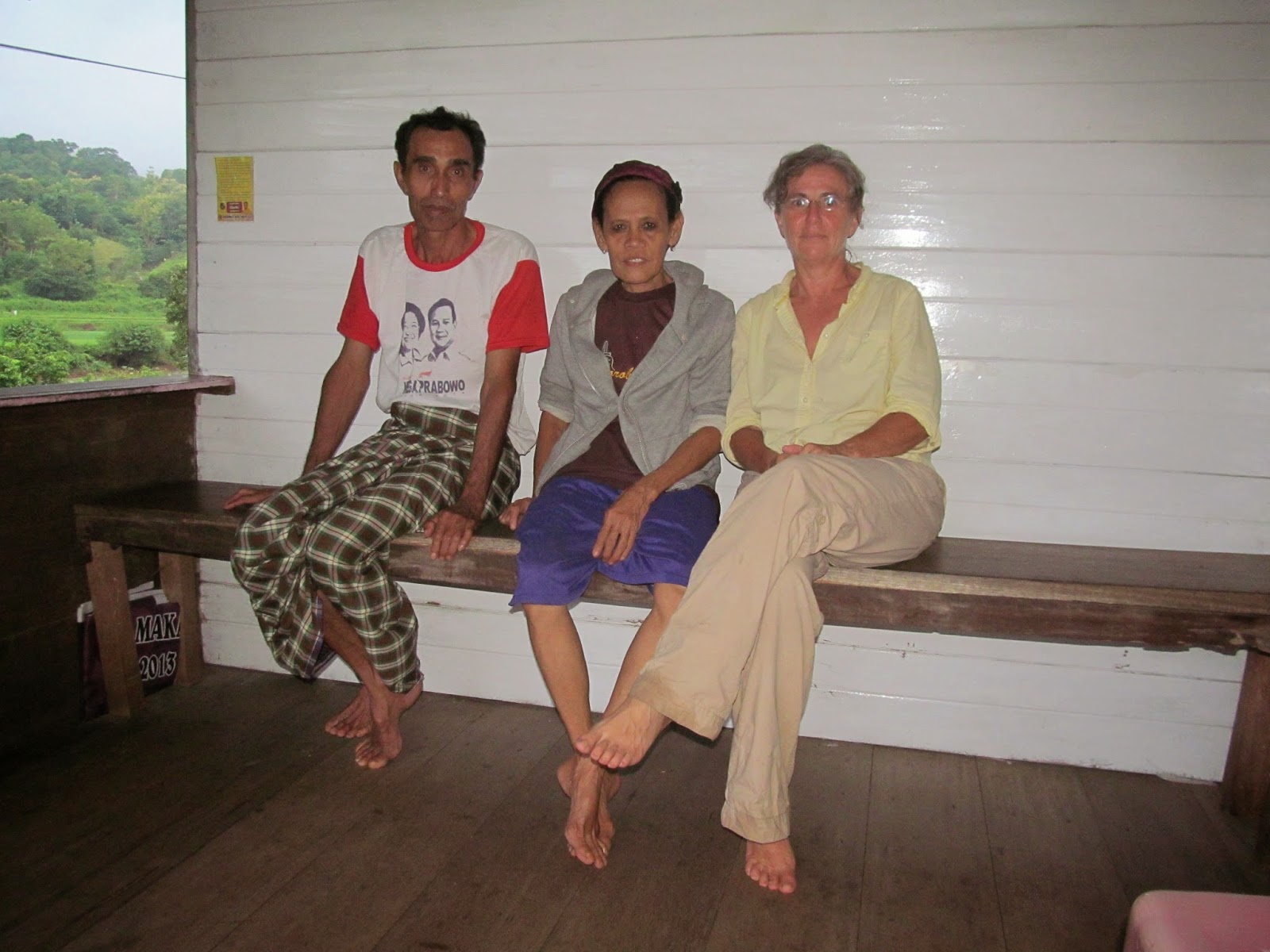
On the porch with Pak & Ibu Hussein at their house. Pak Hussein is the head of his village & also works at Hutan Pendidikan. On this day, Ibu Hussein gave us some delicious sirsak & introduced Kirsten to the wonders of durian fruit (she likes it).


Aya (left) & Emily (right) in the forest last month - Australian teachers who lived in Maros for a year & are now readjusting to life back home. Frequent visitors to the forest, I miss them.


Random schoolchildren- not personal friends, but so cute.

Nasri, Kirsten, Joel & Ikram. Joel is an Australian teacher working in Maros & Ikram is a friend (& maybe my future business partner) from Maros - which, incidentally, is the city I travel through every week to get from the forest to the university in Makassar.
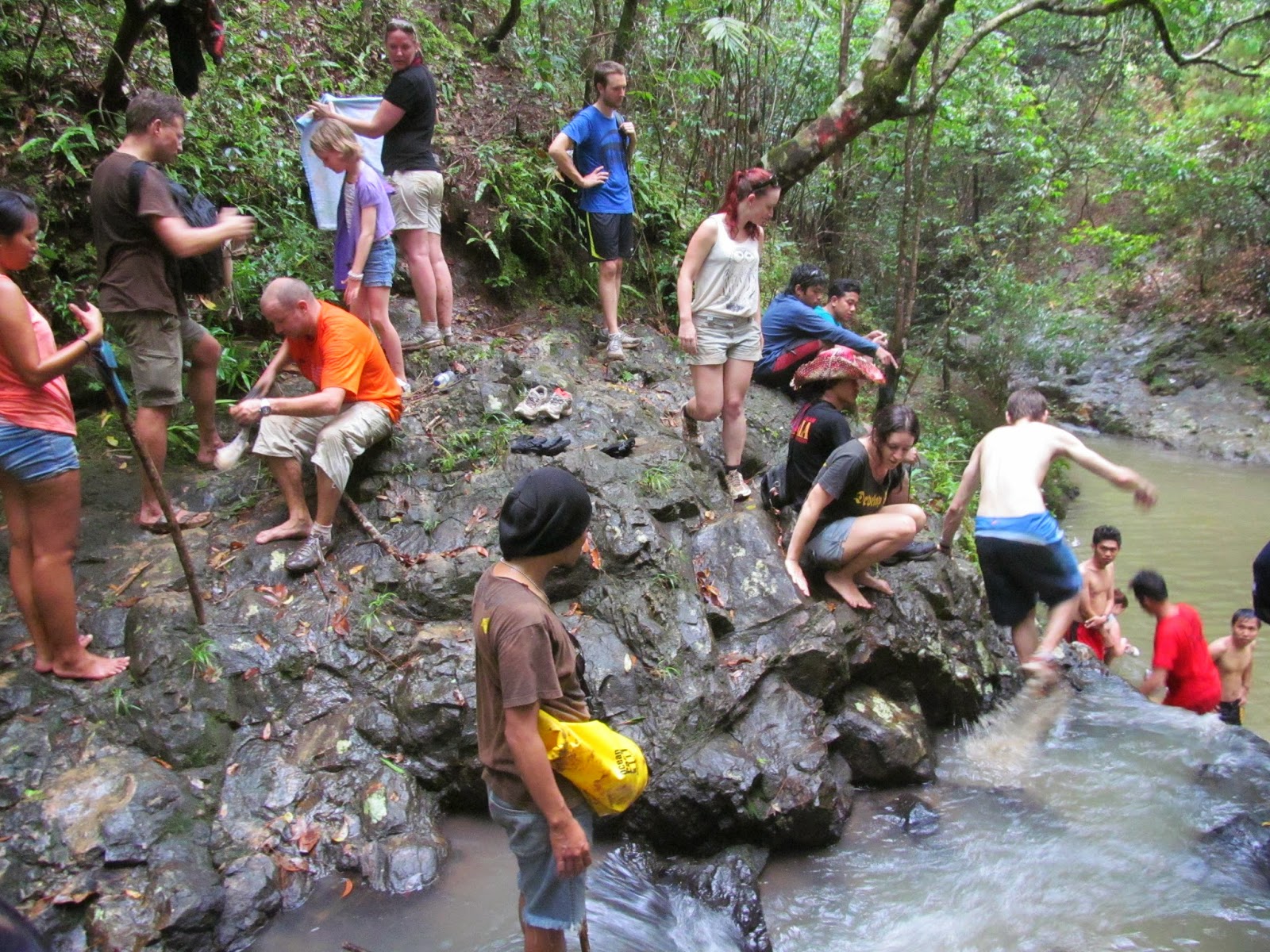
Traffic jam at the swimming hole.


On my last weekend at the forest, it was great to have several friends from Makassar come up for a hike and overnight stay. We went for a long trek in the woods, punctuated by a swim. Let's see - picture above has Titien, Ruud, Jasper, one of Ruud's & Kirsten's children, Marilke, Ipin, Joel, Abby, Annie, someone else, someone else, someone else (we met some other group swimming when we arrived there).

The next day, breakfast at my house. Kirsten &  others (Kir is the white one, newly arrived from home to make sure I get back to Canada).


The Dean and members of the forestry faculty treated me & Kirsten to dinner at a seafood restaurant as a thank you & goodbye. Great people to work with - among others I hadn't met, we have Pak Restu (the Dean, in the blue shirt), Pak Muzrisal, Pak Millang, me, Ibu Yanni, & beside Kir on the other side, Pak Supratman.


And, of course, the management team - Tim Pengelolaan Hutan Pendidikan - Nasri, me & Wildan.

Tuesday, 25 February 2014

This is What I Know (Warning: Not Much)

After a year & a half I think I understand about a tenth of what goes on in Indonesia or to be specific, South Sulawesi - because the characters, customs & hidden meanings can be quite different between the islands - and it seems to me that there are countless contradictions in this country which are simply unintelligible to me raised in a very different culture. It’s tough to even recognize or learn about some of these anomalies.

The first of which, and most obvious, is that everyone is very friendly. In fact, immediately friends-for-life. But not really. While networking goes on everywhere and all the time, it’s rarely followed up. I’ve found out that “You must come & meet my family” usually means “Goodbye, I’ll never see you again”, but never in a bad way. It’s just that those rapid connections are superficial & not pursued. It actually takes a really long time to get to know someone to the extent that you would count them among your friends - people who you would call up, go out for coffee and have a good long chat. Hmmm, maybe this was the society for which Google Circles was invented. 

Indonesia has an intricately structured, highly bureaucratic government - all government workers, including schoolteachers, wear uniforms - and this top-down administrative nature tends to foster an almost extreme reluctance (or inability) of anyone other than the head guy to make decisions. This means that underlings (everyone other than the top guy) can sit around waiting for direction for a really long time before the order / permission / signed letter / stamp gives them the go-ahead to do pretty much anything. On the other hand, this is a busy, commercial society with many independent operators selling everything you can lay hands on in the country, usually roadside in a slapped together stall or out of the back of a vehicle. To establish a business with four walls in a location with an address you need to submit application forms correctly completed, signed and stamped with fees paid in the full amount, but the ‘temporary’ enterprises - which are probably more numerous than the officially registered ones & can support a family until the kids are out on their own in their own fish stalls or durian trucks - are the backbone of everyday commerce (i.e. food, household supplies, clothing) in Indonesia.

Inequality between the poorest classes of people and the richest stratum is immense - difficult to find the words to describe just how little most Indonesians earn each year & compare it to how the wealthy people live. I guess I could just say that one rich Indonesian could easily support a village of 1000 residents - build them new houses, pay all the school fees, buy all their clothing, food, etc - without having to cut back on that new fleet of cars. It’s ridiculously inexpensive to live in the country if you eat local food from the market, don’t own a car and don’t mind living without hot water, a bathtub, or several other common amenities. That’s why someone can (barely) survive on a salary of about $65 per month. The ‘Wage Gap’ is a joke here; ‘Wage Marianas Trench’ would be closer to the mark.

The missing element in these strata is the middle class - of course, there is one, but it’s not huge and it doesn’t seem to be growing. Like in North America, rich people (and the moderately well-off) are getting richer while poor people are doing worse every single year. Prices for food, gas and other basic living needs are rising while wages at the bottom level are entirely stagnant. Middle class business owners, doctors & other professionals can quickly move up the ladder because the cost of labour is depressed (ergo, cost of new housing, luxury goods is kept fairly stable). There are millions of young Indonesians with post-secondary degrees that are underemployed or can’t get work at all - their entry into the middle class is blocked. In another country these educated young people might try to emigrate, but unlike those from the Philippines, Malaysia, China, India, etc. I haven’t met any Indonesians who tell me they have a relative living out of the country. Not one. I’ve met several who have been to Australia, Japan, Holland, the US and Canada, either to study or visit, but have yet to meet one who says they know someone or that they themselves want to emigrate. That’s unusual. 

You can conclude from this that family is probably of paramount importance in an Indonesian’s life. And it’s true that if one member of the family gets ahead - starts a business that becomes very successful, or breaks into a position in government - the rest of the family will directly benefit from either wage-sharing or getting jobs themselves through the first one in the door. With large families and the possibility of living a very good life on a moderate income here, those opportunities just might be worth the wait.

So, let’s talk morality. Indonesia has five official religions - Islam, Christian, Catholic (don’t ask me - ask the Indo government), Hinduism and Buddhism. To apply for a long-term visa you must choose one of the options on the official form. There is no ‘other’ choice. Either in contradiction to this, or because of it, Indonesians are very tolerant of anyone not of their own faith. (I’ve heard this is not as true in western Sumatra, where they are cultivating a nasty brand of radical Islam.) We get more official days off per year including all the important days for the five religions as well as Chinese New Year, thanks to the influx in the past century or two of many Chinese immigrants. The different character of the islands is often a result of the predominant religion on those islands - if you need a decorative wooden penis the markets in Bali, with its largely Hindu population, are the places to go. A regular boys’ night out with beer flowing is best had on Flores (mostly Catholic). Most people in South Sulawesi are Muslim but there are large areas, particularly in the northeast, with Christians. Toraja, one of these Christian areas, is very well known for its intricate burial rites with herds (and herds and herds) of animal sacrifices during the funeral services. Modern religions (i.e. those created in the last 2000 years) seemed to have just slid right in and made themselves at home among more ancient customs on these islands. 

Where you have religious strictures, you have people breaking these left, right & centre, right? Right. Most villagers would not touch beer or wine, let alone hard liquor, but ballo - oh yeah, pour me one. This is the local hooch, made from palm fruit, with a higher alcohol content than beer. I’ve heard two reasons why this is perfectly acceptable to practicing Muslims - one is that it’s natural - made locally, not officially bottled, just poured into a pre-used water bottle for convenience of transport - from all-natural ingredients. (I can hear hackles rising on home-brew wine & beer experts from here.) The other reason is that one or two, that’s okay, just as long as you take it in moderation, there’s no problem. Let’s leave it at that. 

But then if you’re really craving a cold beer there’s always a guy, in even the smallest villages, who keeps a few bottles under the counter for discreet purchase. You just need to know who to ask. (Everything that happens here always comes back to networking & I really wonder how things worked before cheap cellphones inundated the country.)

So, one or two sexual indiscretions (a year, a month or a week) - no problem with that either apparently. Prostitution is, well, maybe not rampant, but you hear about it a lot here. And I mean a lot. The city street facing Makassar’s port is wall to wall karaoke bars. (Important translation point: ‘karaoke bar’ = ‘brothel’, while ‘family karaoke bar’ may = ‘karaoke bar’, but not always). Well, you can certainly expect that in any port city or any city anywhere in the world. A lot sadder to me was to visit a beach resort town in another, quite rural, area and see a long stretch of windowless, concrete block buildings on a dirt road which cater to men who seem quite willing to drive 3 or 4 hours for the sake of discreet indiscretions. 

However, cheating on your wife with someone else’s wife may result in death, for both of you. Not legally, of course, but I’ve been told no one would investigate. (But remember, my informants may just be having a joke at my expense, I’m just passing on what I hear.) And unless your sweetheart, whom you have just asked to climb down a ladder and run away with you, first barely misses your head with an intentionally-packed suitcase full of clothes to accompany her, you’re in deep trouble. Life-ending kind of trouble. So grab her backpack at the very least before she hops on the back of your motorcycle. Otherwise it’s considered, well let’s call it, ‘grand theft wife’ because marriage is expensive for men here. They must collect up to 40 million rupiah (about $4,000) to donate to wedding expenses before marrying their fiancee. Unless they want to settle for a nice girl from Java - for some reason their weddings are much cheaper, only about 1 million Rp. This leads to several sad single Sulawesi girls and probably a lot of sadder love songs.


So, I’m still learning a lot here & the most fascinating lessons from this society are the contradictions that seem to saturate every part of it. 

Thursday, 23 January 2014

Well, it is a "rain"forest


The show started in traditional fashion, with traditional dancers.

 Skit depicting the oppression of the working classes by corrupt and uncaring officials (standing in the back with crossed arms and disapproving looks). The mud added an impressive dash of realism to the oppressed actors (in foreground, writhing on the ground. 

Singers & drummers.
Happy cooks providing late night snacks.
Like forestry students probably everywhere in the world, the Hasanuddin University forestry students hold an annual event to welcome new students to the faculty. This is held at Hutan Pendidikan, usually around this time of year. Last year it happened in late February, just after I arrived to live here. This year, it was a month earlier, and sometimes it’s held in December. Regardless of the shifting date, from my 2 sample points, it may be a tradition to hold it in the middle of rainy season when the campground that a hundred or so new students call home for the weekend is knee-deep in mud. A good introduction to living rough, I guess. But lots of fun in any case. Students from 2nd, 3rd, & 4th years put on a variety show with songs, skits, parodies and fireworks, and despite the temporary intermission for rain, it all went very smoothly again this year. There are some very talented individuals in the faculty.


Ebony germinant.
Although many of the forestry undergraduates and graduate students come to the forest to establish sample plots and gather data to complete their thesis requirement, most projects are of relatively short duration. My work partner Nasri plans a longer data collection period for his Masters thesis, spanning at least a year. I’ve been out with him a couple of times to help set up his plots and record data - it’s an interesting question. He’ll be tracking survival rates of newly germinated and one-year-old ebony seedlings. Part of the project is also looking at distribution of fruit and seeds, but this gets complicated because monkeys, birds and other fruit predators spread the seeds liberally. Without knowing what animal is eating the fruit and how far from the parent tree it’s taken, it’s difficult to make any predictions about seed dissemination. Left to its own devices, the heavy ebony fruit falls straight down, leading to the reasonable conclusion that it germinates in shade, a secondary succession species. Nasri’s project should be able to indicate the effects of competition on new germinants, and possibly determine the optimum level of canopy cover for seedling survival.
Nasri tagging seedlings - well over 300 in one plot.


Everywhere I look in the forest there are opportunities for long-term research projects: revegetation following landslides, preferential fruit predation by bats, exclusion of grazing animals from pasture to look at natural succession, etc. etc. etc. Cristina, newly back from four months in Italy, will be hosting two more Italian graduate students for several months starting in March, who will be studying “her” monkeys, the moor macaques, followed by two American students in the summer. The possibilities are endless here.


But, of course, the rain can slow us down. The day we went out Nasri & I only finished one and a quarter plots before it started and we ran for cover, so it’ll be a couple more days until plot establishment is complete. That’s okay, it’s the most fun you can have in a forest, right?


Rebecca & Tina hiking in forest.


Well, almost. The previous week we had two Aussies visit, Tina & Rebecca, & we were lucky enough to have several rain-free hours to go hiking & swimming. Our waterfalls are in full flow right now, & they're beautiful.
Rice in the rain.


A good reason to always carry a camera - you never know when you'll see a pete-pete (local bus) that makes you laugh.