Tuesday, 10 December 2013

Jalan-jalan on Java


Orchids at Kebun Raya Bogor
I’ll need a long rest over the next week - this last week I’ve been seeing a tiny bit of Java (pronounced “Jawa” here). When you look at a map of Indonesia, the impression is of a series of small islands strung in a necklace configuration. What’s lost in the overall picture is how big some of these islands are - Java is the fourth largest island in the world. So, my “little trip” turned out to be mostly moving from one spot to the next - but there it is.

The annual VSO volunteer conference was held in Jakarta, which is home to 28 million people. Ok, sit back, close your eyes & imagine almost the entire population of Canada living & working in an area smaller than the GTA. Traffic? Well, yeah. Jakarta, like any big city has it’s run-down areas, but also has some really beautiful streets & neighborhoods, like embassy row. And hands down, they have any Canadian city beat for the diversity & creativity of its skyscrapers. The city is developing rapidly and most of these are very new. 

It was great to see all of the volunteers currently working in Indonesia, although we are very few & our enthusiasm is slightly dampened because of the closure of VSO Indonesia in 4 months. After the three-day conference, I took myself down to Bogor, which is about an hour southeast of Jakarta. It only took me 3 hours to get there, following one key mistake at the train station, leading to a search for a bus station, ending up at the wrong bus station, taking a local pete-pete to the right one, then finding THE bus to Bogor, after which it was a comfortable, as-advertised, hour-long trip. I had arranged to meet a couple of people who work for CIFOR (Centre for International Forestry Research) to talk to them about the UnHas forest and see if they had any suggestions on solving some of our problems. That was successful & they had some useful ideas, but the best part of the trip was serendipitously meeting Tom, my homestay (B&B) host. Well, maybe not so serendipitous, his was the first place to pop up on a Google search for Bogor homestay. In any case, throughout my badly planned rapid tour of Java, I met so many people who helped me out - the first of whom was the guy at a travel agent’s office. He used his web link to find Tom’s homestay, then drove me to the house, made sure I thought it was OK, then left with just a thank you.

Tom the botanist & me, at entrance to Kebun Raya Bogor
Tom is an avid botanist & environmentalist with a doctorate - now, my grasp of bahasa Indonesian is OK, but it’s still tough to remember long conversations because my brain is still translating while I’m listening. But, I did gather he worked in Sumatra studying elephants for a while & he showed me his name as contributor to a key plant identification book. He’s retired now & runs his homestay where he has a display of pictures of visitors from all over the world. 

When I reached his house, I had already met with one of the researchers with whom I had made an appointment, but was planning to go to CIFOR main office later that day. Tom insisted on personally escorting me to the office via local buses & waited for me for the trip back, with a little side walk through an area of forest to look at some trees. Rain & rest for the remainder of the day.
Old Dutch graveyard in Kebun Raya
The next day he suggested a walk through the Kebun Raya, botanical gardens which were established in 1817 by the Dutch botanist Reinwardt. Absolutely beautiful & Tom knows them like the back of his hand, guiding me to the most interesting corners with an extended discussion about the plants, their origins & uses. This was the highlight of my trip to Java - ahhh, plants!
When it was time to catch the bus for my next destination, Tom again insisted on escorting me to the bus office & waiting until its departure. By this time, I’m beginning to feel self-conscious & incompetent. Do I look like an old confused lady who desperately needs help to manoeuver the country? I’ve become quite comfortable just asking anyone & everyone on the street for directions, but having Tom lead me around everywhere during my short stay in Bogor actually lowered my self confidence a bit. Maybe I’ll just choose to believe he was bored & was enjoying talking about plants with me. There was no one else staying at his house when I was there & he can talk quite a bit - my contribution to our discussions was mostly just listening & nodding. His last kind act was to hop back onto the bus where I had settled in & give me a big bottle of water. I’m now beginning to worry about his common sense & profit margin - he charged me 90,000 Rp. (between $8 to $9) for the room, but paid for the bus rides around the city if I didn’t have the money in my hand giving it to the driver fast enough, & then the water. 


So, this is where distance & underestimation of Indonesian geography comes in. What I should have done is take the train to Jakarta then gotten a train to Yogyakarta, which would have been a comfortable 8 hour trip. What I did do was bus from Bogor to Yogya, kind of a gruelling 18 hour trip, luckily done overnight, which did save me a hotel bill. And, in an executive bus, with comfy seats, but still not a fun night. And not what I had planned, because looking at a map I was hoping to go directly from Bogor southeast to Yogya.  My bus was routed back to Jakarta, all around the outskirts to pick up passengers, and then on the highway through the centre of the island. That added about 6 hours to the trip. Had I known... oh well, lesson learned, plan your trip better, right?
Borobudur

Landed in Yogya early in the morning & wandered around a bit hopelessly until I found another homestay run by a nice couple, Makurna & Linda. I arrived too early to check in by any hotel or B&B standards, but they let me come on in without mentioning the time, & made me coffee & breakfast. Yogya is a well-known cultural centre with many silver & batik shops, so I thought this was a good place to see with only a couple of days on Java. My plan here was to first visit Borobudur, site of a restored Buddhist temple & my host generously drove me to the bus station to catch a local bus to the town, about an hour north of Yogya. I wandered around the huge temple for a few hours - it was Sunday afternoon, so quite a few people everywhere, except the adjacent museum for some reason - that was empty. During the bus trip back it started pouring - well, it is the rainy season. Caught the city bus to a main tourist shopping area which is under cover & browsed the batik shops, which are endless in number, but not necessarily variety. Ended up back at the homestay more than slightly damp & with absolutely no clean clothes left, so it’s time to go home. Flight back to Makassar the next day, with laundry the priority item.
Closeup of stone carving, Borobudur

Interesting trip - I’m starting a personal tally & this trip I can rack up getting lost twice in Jakarta, twice in Bogor & twice in Yogya, a suitably balanced record. While it can be frustrating, it seems to be my style of travel & certainly leads to some unique discoveries. Friendly people (almost) everywhere really enhance travel throughout the country - they all want to chat, give you advice about things to see & often invite you to their homes. Unfriendlies? Well, some taxi drivers can be looking to take advantage, & surprisingly often don’t know their way around the cities - one of my “lost” adventures in Jakarta was in a taxi, & I finally gave up & walked back to the Yogya homestay after no one driving a cab or pedi-cab knew the address & an ojek (motorcycle taxi) driver wanted to charge 3 times what the ride should have cost. 
I’m still the reticent Canadian - when I travel at home, the number of people I would spontaneously talk to over 3 days would probably be about 3. This is a list of people I had quite lengthy conversations during this short trip, sometimes as a result of a request for directions, other times just because I was there & someone was curious & friendly.

Lady on bus to Bogor, chatted in English
Guy in travel agency, found me a homestay, drove me to it, talked, introduced me to his son
Tom, as above
School group in botanical garden, teacher chatted, took picture of us all
Man sitting on bench in garden, chatted about family, 3 kids
Man on bus to Yogya, 2 wives, one in Borobudur, one in Surabaya, 3 kids between them, works in Jakarta, offered to arrange a hotel room in Borobudur, but I declined (would have meant getting off the bus at an unknown location)
Guy driving pedi-cab in Yogya, recommended homestay, drove me to it
Mukharno & Linda, 2 adult sons, one still in college studying economics, one with 2 kids of his own, Linda originally from Yogya, Mukharno retired 2 years ago from job in Jakarta, they moved back, bought the house, which had been built by a Dutch man, restored it, started their homestay
Girl working in museum in Borobudur, studied archaeology in Cologne, husband lives in Makassar, wants to stay here, but will probably move to join husband
2 young guys at bus station in Borobudur, offered an ojek ride, but due to rain I declined, waited around with me for the bus back to Yogya, chatting, the only two English words one of them knew were “Quebec City” - hmmm. The other one offered to come back to Canada with me.
Borobudur

Monday, 25 November 2013

Putting Someone Else to Work: Leslie's Tech Visit

Leslie with the local farmers in Bengo-Bengo
Checking out composting 
One of the ways VSO encourages exchange of knowledge is to sponsor technical visits by volunteers to other placements to conduct workshops in their area of expertise. As a side benefit, we get to travel to other islands, do a little bit of sightseeing, & visit our colleagues. This month, Leslie, an agronomist from Toronto, came to South Sulawesi at my invitation. He’s been working in Ende, on the island of Flores, for Universitas Flores, arriving at the same time I did last year. So we invited him over to give a lecture to agriculture students at Universitas Hasanuddin on the theme of modern forestry. Although the timing was - hmmm- flexible - we finally rounded up about 50 students, a projector, several cameras, and Leslie at the podium, resulting in a captivating session. He was quite impressed with their questions and involvement in the subject; it was definitely a success.
Farmer in the forest
The next day, Nasri & I took him up to Bengo-Bengo, where he conducted a workshop on organic composting for about 20 local farmers. Again, several questions, lots of interest, followed by a walk over to one gentleman’s house to see the efforts he has started with composting & fish pond culture. One more check mark for the good guys. Feels especially good for all of us to arrange something as a team & have it work. We also squeezed in a forest hike, and Amir made his specialty dinner, ikan bakar (grilled fish) for us and Rui, a Japanese graduate student who is doing her research here. Post-dinner conversation included a brief lesson on Japanese greetings, against a mellow background of Italian opera.

Nasri & Rui in the woods
Feeling confident, we try for 3. On Thursday we made our way down to Maros to attend a workshop on waste management given by Margaret for the International Citizenship Volunteers (ICS), the group of 16 youth volunteers from England and Indonesia. Margaret, from Cape Breton, has been working in Puntundo, Takalar province (about an hour & a half from Makassar, on the south coast) for an environmental education centre since March of 2012. After Margaret’s activities, Leslie stepped up again, recapping the organic composting session for the youth volunteers who are working with local villages on several fronts; mangrove rehabilitation, composting, organic farming & environmental education (more about this in the next post). 

Margaret rocking her facilitation

So, after what I think we can honestly call a knowledge transfer hat trick, we quit while we were ahead & got ourselves back to Makassar. On Saturday, Margaret, Leslie & I met up with a couple of instructors from Humber College who are working with 7 universities in the city teaching entrepreneurship training. We took a choppy ride out to one of the small islands off the coast & lazed around on a beach for the afternoon. Back to the main island in time for a sunset beer at one of the local bars, where the large group of expats started to trickle in after their weekly hash run. Leslie was impressed; he’s one of only 2 expats in his city of Ende, and doesn’t have the opportunity to play with Aussies, English, Dutch, German, etc. etc. people as often as we do here.

ICS volunteers paying close attention to composting talk
Sunday morning included a rushed, but necessary trip downtown so that Leslie could shop for oleh-oleh (little souvenirs from any trip away, expected by Indonesians as gifts when you get back), then a quick goodbye, & he headed off back to Flores. A busy trip, but it all went much better than expected. And, we all got to enjoy seeing Leslie's large selection of batik shirts.


Monday, 21 October 2013

Time for Plan "C"

How bad does your career karma have to be to get laid off from a volunteer position? I’m guessing pretty bad. Re. last post: “will I persist for another year?”. Turns out, that’s not up to me. Not only is CUSO terminating its partnership with VSO Indonesia at the end of March 2014, VSO is closing its operations entirely in Indonesia. Hmmm. When they said we would need to be flexible..... So that’s it. Five more months, at the most, and I’m finished here. 

There were rumours floating around about cutbacks and changes at CUSO, obvious signals from the Conservative government, particularly when CIDA was dissolved as an independent agency and sandwiched into Foreign Affairs. I haven’t read anything about other changes - I’m assuming there are other reductions in support for international development as has been consistent throughout the Conservative’s time in power. And, in fact, I’m in favour of this reallocation of resources. Although my stomach dropped when I got the news a week ago, Indonesia doesn’t need foreign aid anymore. Their economy has been growing at a faster rate than Canada’s for several years, and the country has many trained professionals who could fill any of the positions the remaining Canadian volunteers are currently holding. Government departments at all levels seem to be well-staffed. If their funding isn’t spent appropriately on programs, and rather is disappearing into a well of official visits and new vehicles, then that’s an upper management problem that won’t be solved by an international volunteer working at the village level. We have no ability or authority to affect those issues.

While CUSO is terminating programs in Indonesia, Tajikistan and Cameroon, new programs have started in South Sudan, Myanmar and the Congo. It’s all decided on the basis of country GDP, estimated rates of poverty and national government support of development programs, among other indicators. 

Also, Indonesia is awash in NGOs with many different objectives: saving the coral reefs, saving the turtles, saving the rainforest, saving homeless cats and dogs.......it goes on. There are so many NGOs operating that fundraising competition is fierce, resulting in less donor dollars (or rupiah) for each individual organization. This is a classic tug-of-war - do you want your development organizations to be centralized, with many areas of expertise, and a larger administrative requirement? This may result in more effective fundraising efforts and bulk economies for training, provision of resources. Or is the better option to have many small organizations each with narrower focus - lower administrative costs but also a shorter reach for fundraising, expertise and impact.

Another entry into the development market is Corporate Social Responsibility (CSR) programs. Essentially, businesses start their own local improvement projects in areas where they are operating, sometimes to mitigate negative environmental impacts that can result as side effects of their operations. This form of development has great possibilities, primarily because it is less dependent on outside fundraising. Money may be solicited from employees, or budgeted from the company’s own resources (and used as a tax deduction), and people to do the work may also be community-minded employees volunteering in their free time. As with many new initiatives, a burgeoning market in contracting experts to recommend meaningful CSR projects has sprung up in many countries. The emphasis on local issues is particularly helpful. Typically, projects with a broad sweep (like saving coral reefs) can become overwhelming and suck down resources at a mad rate due to the geographical span alone.

Things weren’t going swimmingly here. But I have accomplished a few things, and there was the strong possibility that, given another year, I could have made more progress. In fact I feel like I’ve only just settled in, created some good working relationships, and begun to understand how to achieve results, so having only 5 months left rather than a full year, is very discouraging. Not to mention having to start the soul-destroying routine of searching job boards and writing cover letters.


Might be harder on Alex, ‘though - he’ll need every day of those 5 months to clean up the house & put it back the way I left it. Better get started, hon.

Thursday, 3 October 2013

My Annual Check-up

Well, I’ve been a bit lazy & haven’t written anything for a couple of months, & then thought I’d wait until the one-year anniversary of my landing in Indonesia (October 8) - maybe pull out some profound ponderings on how the year has been for me. I find myself bereft of clever & profound right now, ‘though. Maybe it’s because I’ve never been someone who paid a lot of attention to the past - always trying to see what’s coming next & hoping it’s different. But I’ll try. Here are a few observations.

Lost about 20 pounds (yippee) - mostly due to drastic reduction in alcohol intake - which makes the heat more bearable - fewer fat folds in which the sweat can accumulate.

Learned to love riding a motor scooter, even in wicked traffic. Still swear at other drivers but that’s not going to piss anyone off because (a) it’s in English & most of them wouldn’t catch the meaning, & (b) it’s mostly just resounding inside my helmet.

I don’t get to go swimming hardly ever! Imagine living in the middle of a bloody island archipelago & I can’t manage to get down to a beach even once a month. Conclusion: I need another vacation, soon.

I can plan the hell out of the organization I’m working for & none of it will survive 5 minutes after I land back in Canada. After a year, I’m still trying to figure out how to convert anything I do to have even a minimal lasting impact.

Finished an online social psychology course which reinforced & complemented a lot of impressions I have about society in general & helped me understand some things about Indonesian society that are a mystery to me. The most interesting thing I took away was the affirmation that attitudes & behaviour are often completely disconnected, so if you want to change something people do (like littering) you’re probably wasting your time (& money) trying to change attitudes (for example, through a public information campaign). The effort may be better spent on simply working to change the behaviour. So I yelled at one of the university students on campus yesterday for throwing a used water bottle on the ground (well, OK, I didn’t actually yell - but I did tell her she shouldn’t be littering). 

It’s great having 2 homes here - one up in the cool hills among trees & one down in the city. I don’t think I’d be happy living full time in either one & it’s like a mini-vacation / change whenever I go back & forth.

Makassar is the fourth largest city in Indonesia & I’m surprised to find that I kind of like it. It’s dirty, noisy, confusing, hellish traffic (as I may have mentioned 6 or 7 times by now) - but it feels alive & vibrant. And the Starbucks has the most reliable wifi connection I’ve found yet. I still have 90% of the city to explore - have generally been staying on the streets I know & I still get lost with remarkable regularity - but there’s tons more of it with interesting little shops & restaurants.

Social connections are the central fact of Indonesian life. People thrive through their relationships with others - that’s how the majority of time is spent by an average Indonesian - simply maintaining existing relationships & creating new ones. Anything that has to get done is accomplished by making those connections with others. This is probably the most foreign concept to me & the most important thing I’ve learned here. I don’t know if I can acquire any kind of skill in social networking (& not the computer kind) but it’s revelatory to me to have the examples in front of me all day, every day & I think I’m improving.

So - am I going to persist for another year? I don’t know - don’t know if I’d even place good odds on it. I miss my fam - but Kir & Alex are getting along fine without me - & I think I even have fewer gray hairs since I’m not looking over their shoulders worrying about them all the time. Well, OK, technically (in the technological sense) I’m still looking over their shoulders, but they find it a lot easier to ignore me for some reason.


To sum up - this experience has been & continues to be frustrating, infuriating, confusing, discouraging, even depressing, but always & still interesting. I’ll probably be here next month, so sampai jumpa.

Saturday, 3 August 2013

Notes from the month of Ramadan

Throughout July, the pace of work has slowed down appreciably. Not only is it the month of Ramadan, It’s also the mid term break for universities; lectures resume in the last week of August. 

There’s one week left to Ramadan, culminating in the two-day celebration of Idul Fitri, a big event, for which many people visit family. “Lots of kue (cake)”, my work partner Nasri tells me. Next week is a holiday for the whole university & yesterday evening I was invited to share “membuka puas” with the forestry faculty and staff. It’s an interesting phrase that refers to the daily time at which Muslims may break their fast - shortly after sunset in this part of the world. Rather than “breaking fast”, it means (sort of) to “open satisfaction”. An animated gentleman gave a long, cheerful speech, some of which I understood, speaking about heaven and the reasons for fasting, and then we were treated a buffet dinner.

To my “new” eyes, the effects of Ramadan seem to be relatively minor - people tend to be a bit more tired, traffic seems to move slower (for some reason), but generally, life carries on pretty much as usual. I asked Amir, Cristina’s research assistant, which he reaches for first on breaking fast - food, water, or cigarettes - definitely cigarettes, he tells me. His daily routine during the last month includes waking up at about 3:30 am to prepare a meal before call to prayer starts at 4:30. Another minor difference, I can hear longer sermons & singing from the nearest mosque during evening prayers.

All the small warungs & food stalls are closed during the day, but in the city, coffee shops & restaurants still operate regularly. In a gesture of propriety, they hang light curtains across plate glass windows. No one is offended if you (especially foreigners) eat or drink while they are fasting - but it’s just not polite to flaunt it.   

People do definitely look thinner now - I noticed some of the faculty members are a bit trimmer. The most obvious effect is that dehydration is evident. I felt very sorry for a team of students who were at the forest last week, collecting samples. Six to seven hours of hill-climbing with no water takes its toll, & I was surprised they would plan field work this month. I went out with them for one day, which was enough for me, & I had a bottle of water with me. Luckily the weather is at its coolest this time of year.


Comparing our biggest Christian holidays with Ramadan & Idul Fitri - well, there’s no mass marketing of consumer goods to celebrate the Muslim religious holiday. Nice to see that retailers haven’t yet figured out how to exploit it in that way. So, I guess it corresponds best to Canadian Thanksgiving Day. Mmmmm, turkey - ok, there goes my concentration.

Thursday, 18 July 2013

Pulau Flores in Pictures

Although I've only been back from vacation for 10 days, it already seems a very, very long time ago. Instead of describing our activities (in short, we ate, we drank, we saw sights). Here are some pictures:

Landscape from boat on the way to Rinca Island 


Lazy komodo hanging around the kitchen area

Walking around Komodo National Park

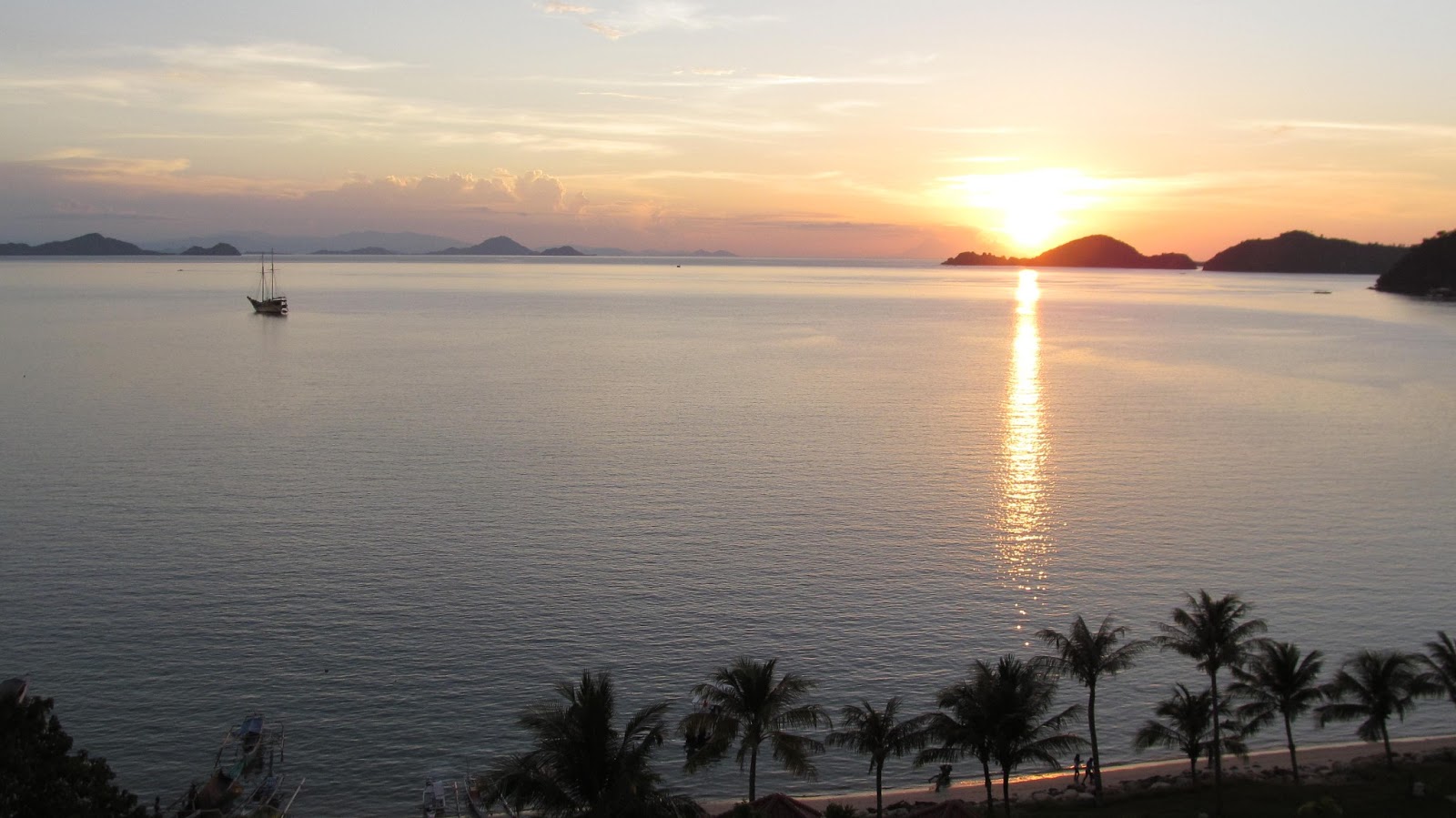
Sunset from hotel room in Labuan Bajo

Lunch with Kir & Pam (in mirror) in Ruteng

Traditional village of Bene, outside of Bajawa

Male figure on top of traditional house

Canada Day in Bajawa: Selamat Ulang Tahun, Canada
"Go be scale for the tree fern, Kir"


Two of the three coloured lakes in Kelimutu National Park


"Go be scale for the volcanic lakes, Kir"
The third lake

Landscape around Moni, where we stayed to visit Kelimutu


Sunday, 7 July 2013

How I spent my winter vacation: Part 1

Kir, tickled pink, on the porch of our homestay in Sanur.
I’ve had a great last 3 weeks exploring a different island with my daughter Kirsten and another volunteer, Pam, who has finished her placement & will be returning to Canada next month. I flew to Denpasar on June 17th & waited at the airport for Kir to arrive on a later flight from Toronto via Hong Kong. Absolutely super to see her, & excited to show her around the bits of the country with which I’ve become somewhat familiar. We spent several days in Sanur at the beach, browsing the fabric shops on Jalan Sulawesi in the city, & eating good food. Luckily most of the restaurants serve both western & Indonesian food, since I wanted the former & Kir indulged in nasi goreng & mie, with sambal, of course.
Kir's dinner: very fancy nasi goreng
at restaurant in Labuan Bajo.


We also rented a motorbike for half a day & spent a bit of time wandering back roads trying to find a particular beach up the coast. Did find it, but the surfing competition we wanted to catch was over for the day & postponed indefinitely due to wind & wave conditions. Still, fun to wander around independently without having to depend on public transport.


A few monkeys in Ubud.
Then, it was up to Ubud for 3 days to show Kir the monkey forest & the beautiful shops, traditional market & more great restaurants & coffee shops. So far, this is a touristy extravanganza & there are many more of us wandering the streets as it is a prime winter vacation spot for Australians & Europeans. Indonesians are also plentiful since most schools have just started a month-long break right now. Many volunteers want to show visiting family members their placement towns or villages, but I was craving a bit of luxury - so our vacation skipped the whole island of Sulawesi. If Kir decides to visit again in the next year, I’ll bring her up to the tiny village of Bengo & show her the delights (?) of Makassar.

Kir comparing the taste of Lay's
salmon teriyaki chips to a previous
experience with Pringle's
seaweed flavour.


Week 2 of the trip had us on a plane to Labuan Bajo on the island of Flores, a well-known destination for diving, snorkeling & seeing the komodo dragons. We planned on 2 out of these 3, neither of us having current dive certification. Pam was waiting for us at the hotel, newly arrived from saying her goodbyes in Kupang, West Timor, where she had been living for the better part of the last 2 years. The hotel was top-notch at a good price, arranged through one of Pam’s friends. Beach front & pool, lovely sunsets.

View from the 8th floor of our hotel, over the harbour of Labuan Bajo.


Next post: pictures of lazy komodo dragons & volcanic lakes (stay tuned).